TEACHER’S GUIDE for Apologia’s EXPLORING CREATION with CHEMISTRY

Finally! A teacher’s guide with NOTES and TEST PREP (and much more) for Apologia’s Exploring Creation with Chemistry, 3rd Edition!

In high school, your students’ education shifts from parent-led to self-driven. Apologia supports this shift by writing their Chemistry high school curriculum for the student. But, to be successful in this course your students need to be great note-takers. Apologia’s Student Notebook offers some suggested methods for taking notes:
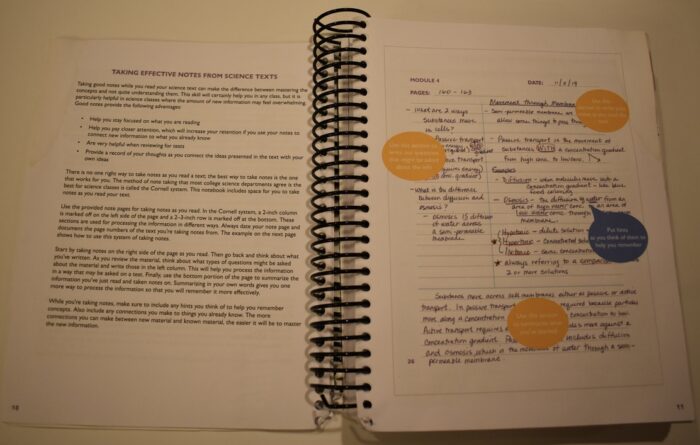
Unfortunately, what you (and your student) will find is that everything sounds important in this course. So, how can you help your students focus on what they need to learn? We created teacher NOTES–for you–to guide your student’s note-taking.

The NOTES identify the information tested in each module, and its location in the text. Using highlight tabs, you will pre-mark that information in the textbook.
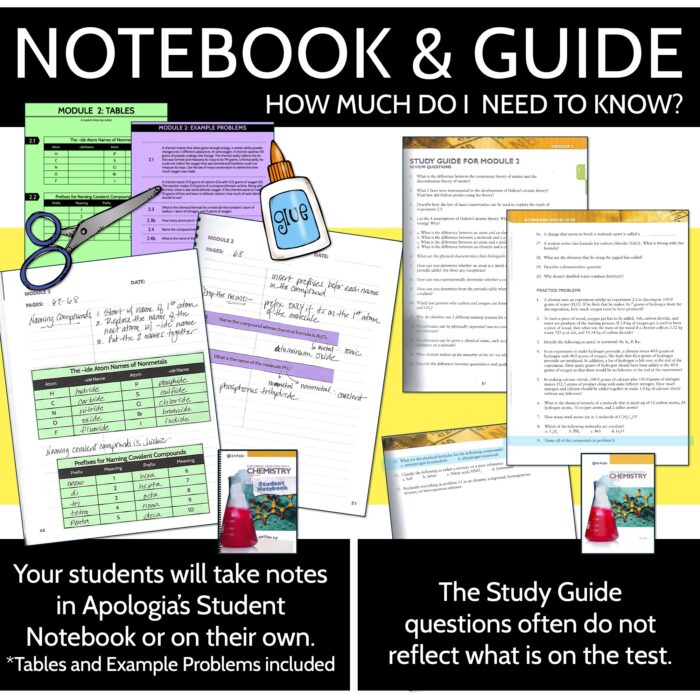
When your students read, or listen to, the text they will know to take notes on the highlighted information. The TEACHER GUIDE also includes all of the Example Problems, and important Tables, Figures, and Formulas. These allow your students to work the Example Problems–and check their work as they follow along in the book. The Table and Formulas can be filled in, cut out, and glued into your students’ notebook.

Another piece to this puzzle of student-led learning is Apologia’s Study Guides. In theory, once completed, your students are ready to take the module test. Yet, the study guide does not always reflect what is on the test.

In the example above, your students are learning how, in Module 2, to name compounds. Similar to the Example Problems, the Study Guide asks your students to name sample compounds. They are also asked to write chemical formulas (as they are in the On Your Own questions for this section).
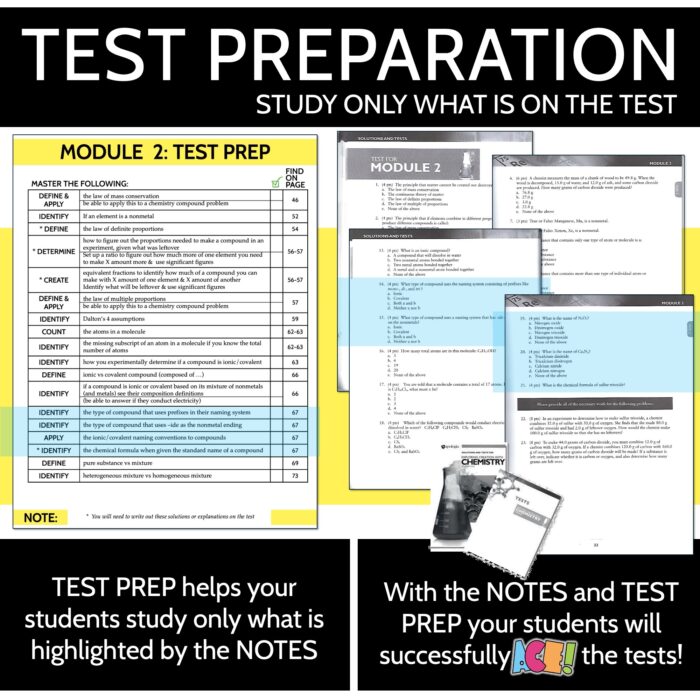
The Module 2 Test asks these two types of questions. However, it also assesses your students’ knowledge of the information from Tables 2.1 and 2.2–in a way that was not previously tested. The TEST PREP sheet makes sure your students are aware of this, and prepared to answer the questions. They help keep your students on track and focus their study efforts. They also identify which definitions or computations will need to be written out or explained (versus matching or multiple choice). The TEST PREP sheets also give the answer’s location in the textbook and a place for your students to check-off each completed study task.

You will also find QUARTERLY TEST PREP sheets in this pack.
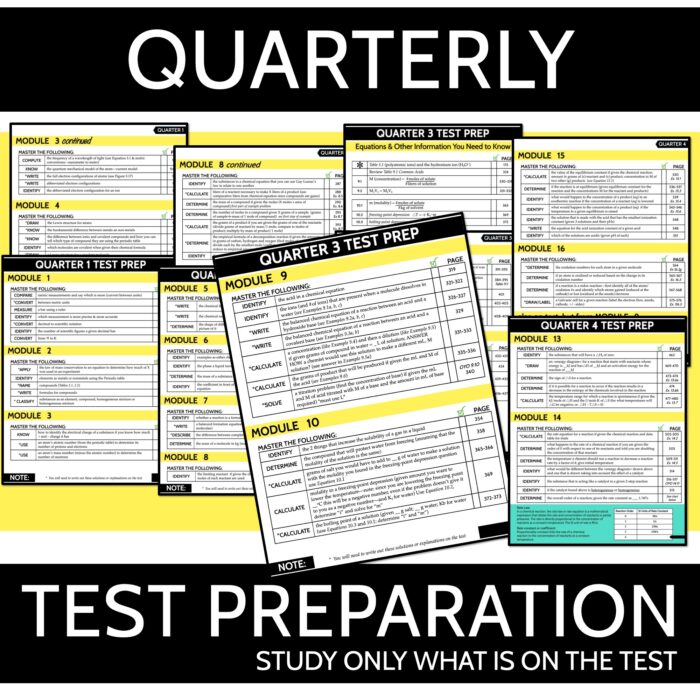
Grab this Teacher Guide for Apologia’s Exploring Creation with Chemistry now while it is on sale. It is going to make this year of Chemistry so much easier!

PreparilliPress and The Chemistry Homeschool Teacher’s Guide are not affiliated, associated, authorized, endorsed by, or in any way officially connected with Apologia or any of its affiliates or subsidiaries.
TEACHER GUIDE for Apologia’s GENERAL SCIENCE

As you transition to homeschooling middle school students, your teaching style will undergo a transformation. One of the subjects you will notice the biggest shift in is science. Instead of parent-led learning, your students will begin independent study and note-taking. They will baby-step into this responsibility, and your oversight is essential to their mastery of the coursework.

We have used Apologia’s curriculum for years and their middle school courses lay a great foundation for high school science. For 7th grade we use Exploring Creation with General Science, 3rd Edition.

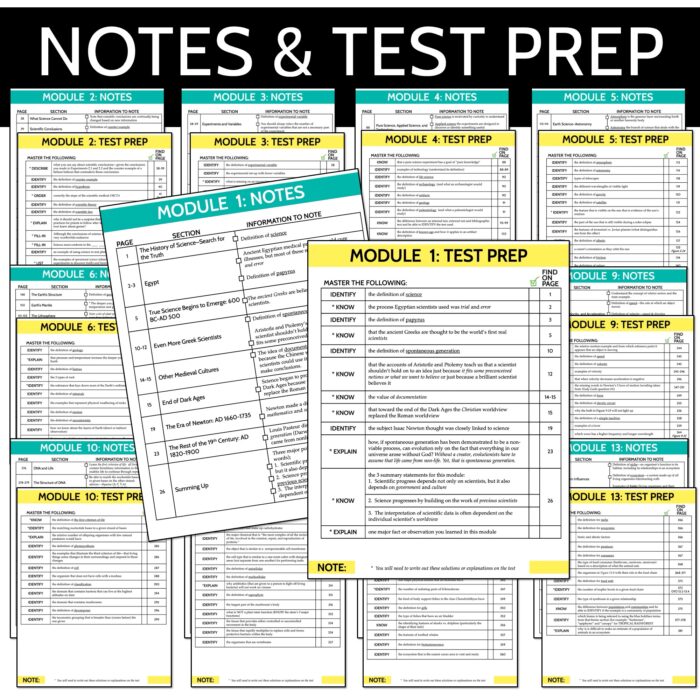
If you have considered using Apologia’s General Science you know that there is no teacher guide. This can be a problem if you are juggling educating other children, or have an infant. So, we have bridged this gap by creating teacher NOTES for you–to guide your student’s note taking–and TEST PREP to help your students focus on specific information as they study for each of the 13 module tests.

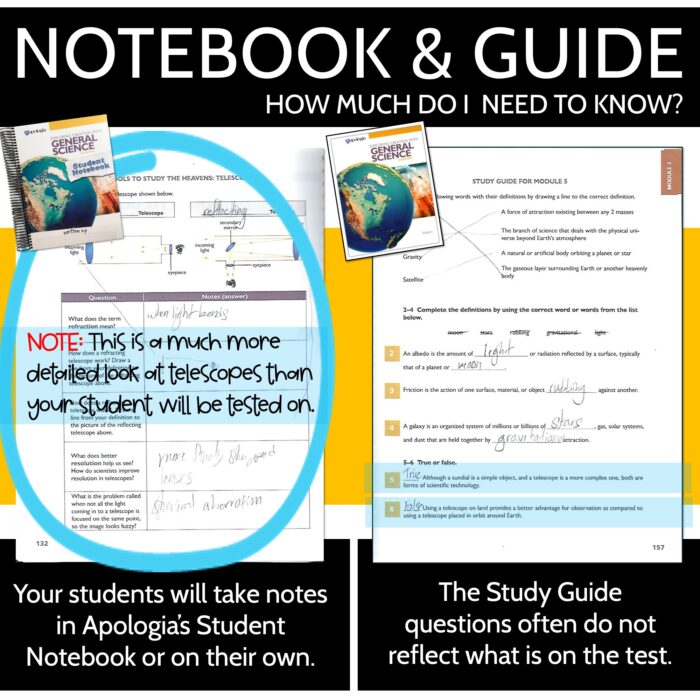
You might be thinking, “Well, I’ve bought Apologia’s Student Notebook and I know they include Study Guides for each module. So, why do I need these NOTES and TEST PREP?” Here is an example of how you will benefit from using them:

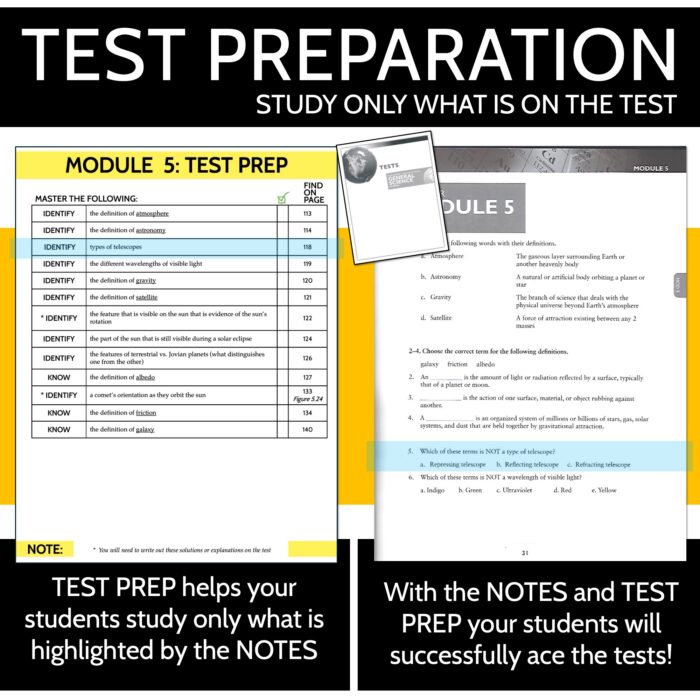
In Module 5 your students will read about refracting and reflecting telescopes. On the Module 5 test your students will simply need to know that these are types of telescopes. This is documented in our teacher NOTES and you would highlight those terms in the text for your students to learn.

Apologia’s Student Notebook, however, asks the student to identify the types of telescopes, define the term “refraction,” describe how the two different telescopes work, discuss resolution and identify the definition for “spherical aberration.” I appreciate my student digging into the text and learning more than simply the names of the two telescopes. But, again, this information is not going to be tested.

Similarly, the Module 5 Study Guide asks two questions about telescopes–one identifying them as a form of scientific technology and another encouraging students to understand the advantages of observation an orbiting telescope provides. Good, thinking questions, but again, nothing that will be tested.

Where Apologia’s Study Guide over-tests, and may even hinder your students’ ability to ace the tests, the TEST PREP will simplify the learning process and focus your students’ studying efforts.

The TEST PREP refers to the information that was in the NOTES and that you tagged in the book. The TEST PREP sheets tell your students where to find the information if they don’t remember it, and also identify if they will need to explain/write-out any answers on the test. Most of the questions in General Science are matching, fill-in-the-blank or true/false, so there are only a couple on each test that are explanation answers.

PreparilliPress’ General Science Teacher Guide is half-off for the next two days. Get yours while it is on sale!

PreparilliPress and the General Science Teacher’s Guide are not affiliated, associated, authorized, endorsed by, or in any way officially connected with Apologia or any of its subsidiaries or affiliates.

FOCUSED PHONICS: Phonemic Spelling for Third Grade

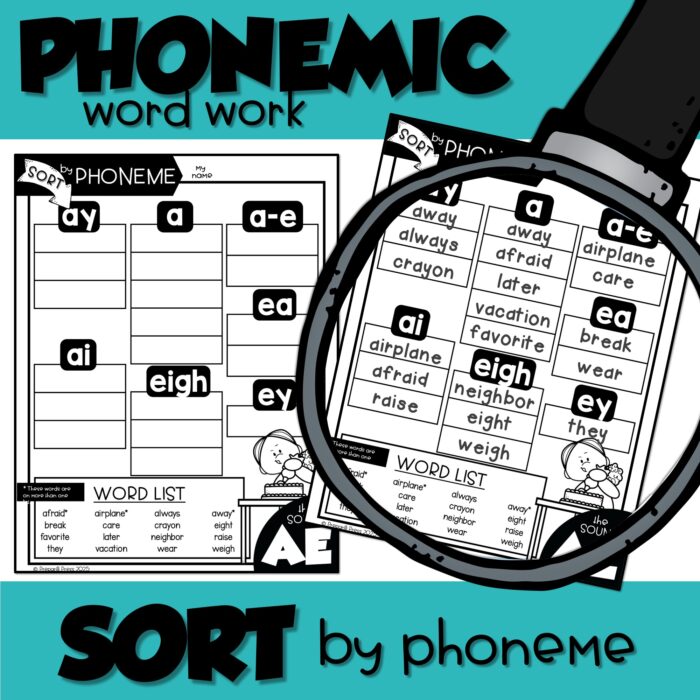
FOCUSED PHONICS for THIRD introduces third graders to the common alternative spelling patterns for 30 familiar phonics sounds. This look inside the LONG A or (AE phoneme) will give you an idea what’s inside each of the 30 packs.

Each sound pack focuses on the spelling of 16 words. These are sight words, high-frequency nouns and other grade appropriate spelling words. Graphically, these words are represented as posters and student-sized cards. The phonemes that the spelling words use are also represented graphically as a poster and a phoneme strip.

The target phonemes are highlighted on the posters but not on the student cards. You will use the students cards to lead a Write the Room activity and your students will use the cards to sort by phoneme (phoneme headers are included).

Each pack has 10 more activities to reinforce the spelling patterns. They include:

Your students should identify the target phoneme in each word on HIGHLIGHT the SOUND. I like my students to also note other phonemes or spelling patterns that might trip them up. We use one color for the target phoneme and different colors for everything extra.

Similar to sorting my phoneme with the student cards and headers, on this sheet your students will write the words under the appropriate phoneme header. Some words may end up being written twice–notice “airplane” appears under the “ai” and “a-e” headers.

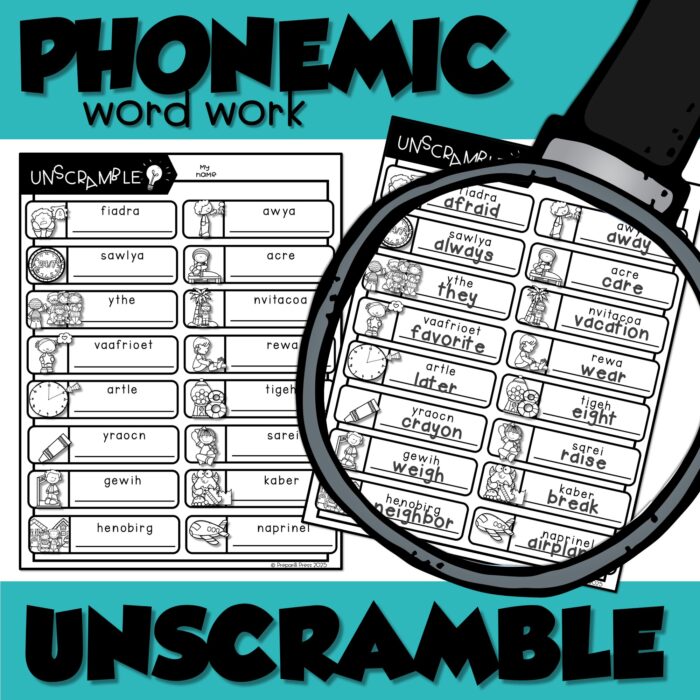
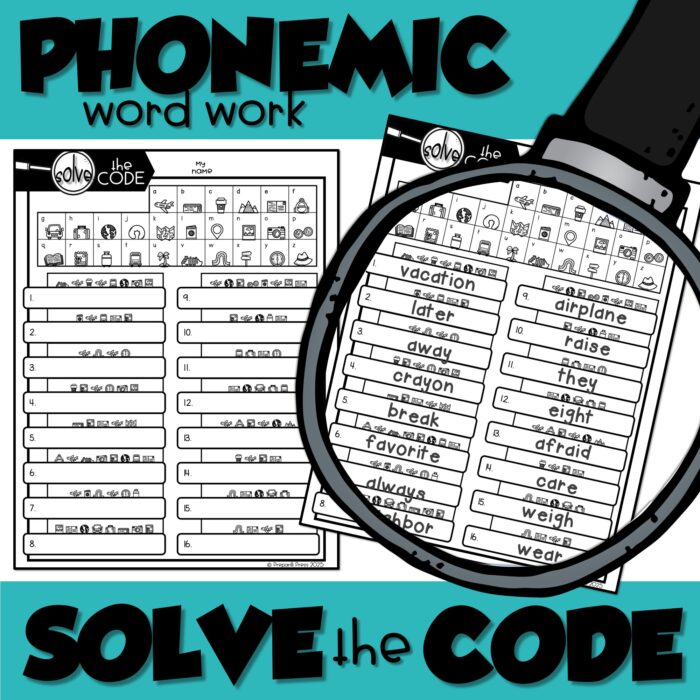
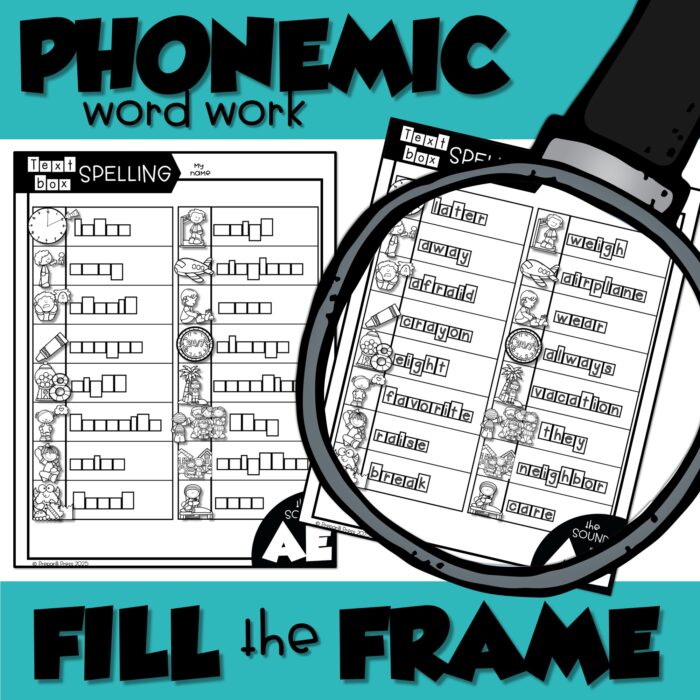
Again, focusing on the phoneme that makes the LONG A sound in each word. Repetition is key to learning these tricky phonetics. Following the phoneme focus, are 4 word work sheets–UNSCRAMBLE, SECRET CODE PICTURES, TEXT BOXES and a CROSSWORD PUZZLE. Each pack includes crossword puzzles with and without the word list.

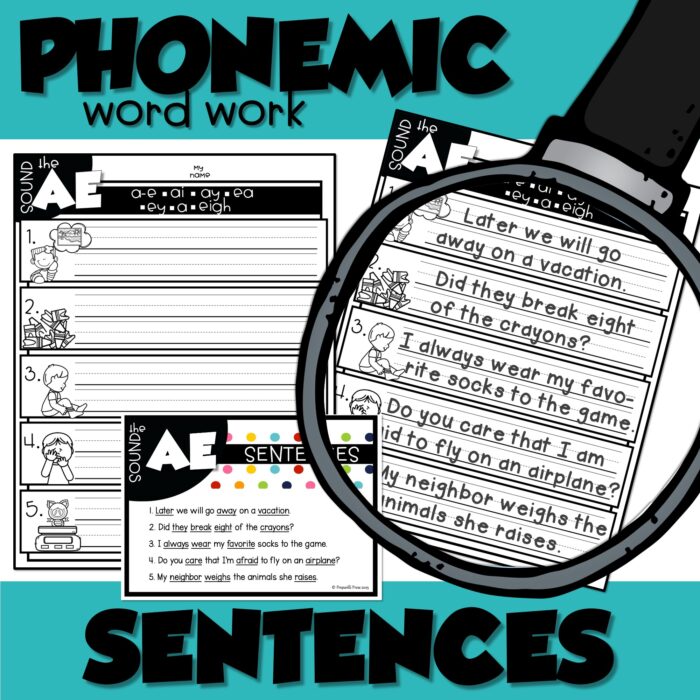
Before the weekly phonemic spelling test, I like to have my students use the words in sentences that I provide. This is a quick assessment activity–it not only allows you to see which spelling words your students are struggling with, but which sentence mechanics (capitalization, punctuation, word spacing, etc.) need to be reinforced. All 16 spelling words are in the five sentences.

And finally, a test sheet. This can be done independently. By the end of the week your students will be very familiar with the word pictures that are used for each of their spelling words.

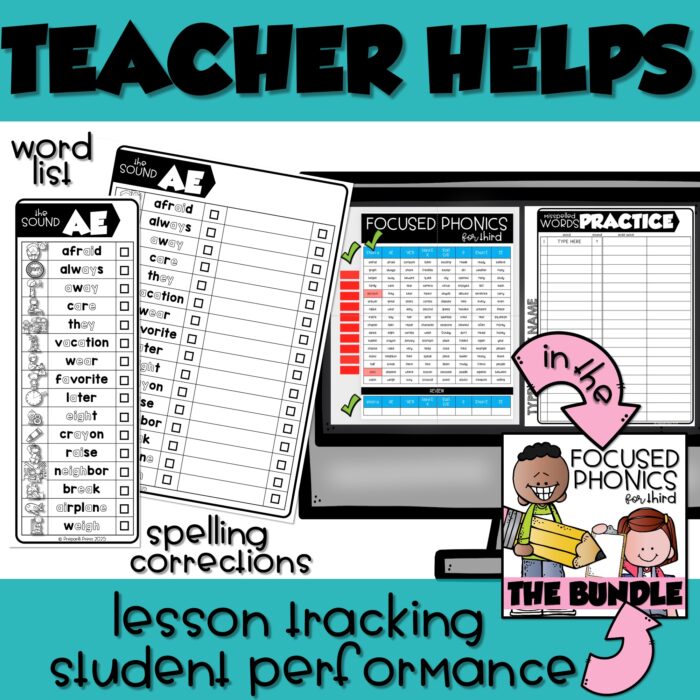
You have couple options for how you have your students work on their spelling mistakes. Of the two WORD LISTS you see below, one can be glued into your student’s spelling notebook and corrections can be made in their notebook. The other can be hole-punched and stored in a 3-ring binder. Practice corrections can be made directly on the sheet.

The FOCUSED PHONICS for THIRD BUNDLE has a BONUS: Word Lists and Tracking! Here you will find a third option for your students’ spelling practice. I’ve included an editable PowerPoint file that includes a spelling practice sheet. Type your student’s name on the sheet, print, and have them log their own mistakes. Or use the sheet track each of your student’s mistakes. You’ll also find the WORD LISTS in this file. Use the red tabs to mark the words your whole class needs to revisit and check the packs that you have completed. Its all in the BUNDLE!

MULTIPLYING with CUISENAIRE RODS

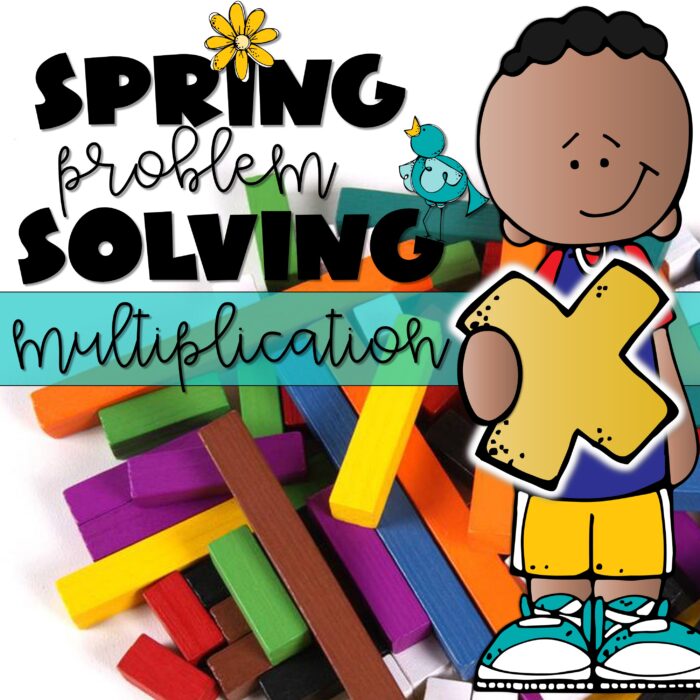
If you have enjoyed using Cuisenaire Rods to practice addition with our SPRING PROBLEM SOLVING K to 1st, you are going to love the multiplication activities in this new set!

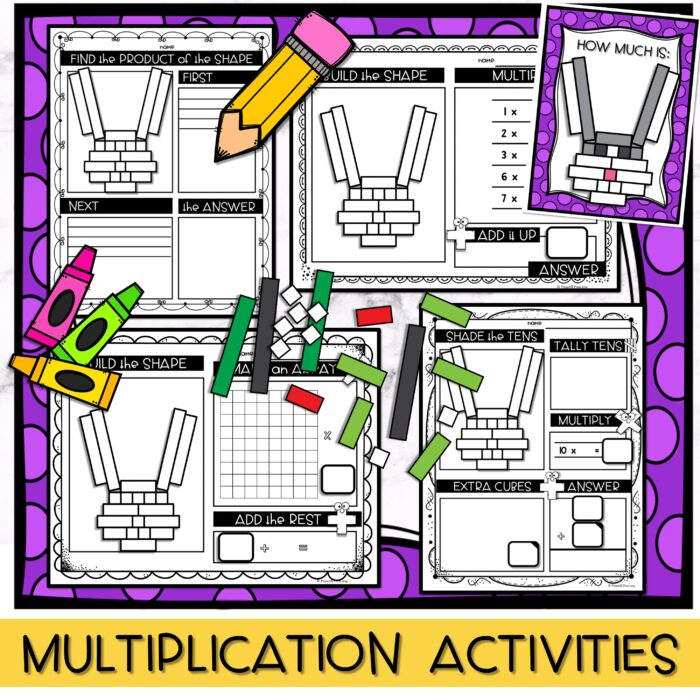
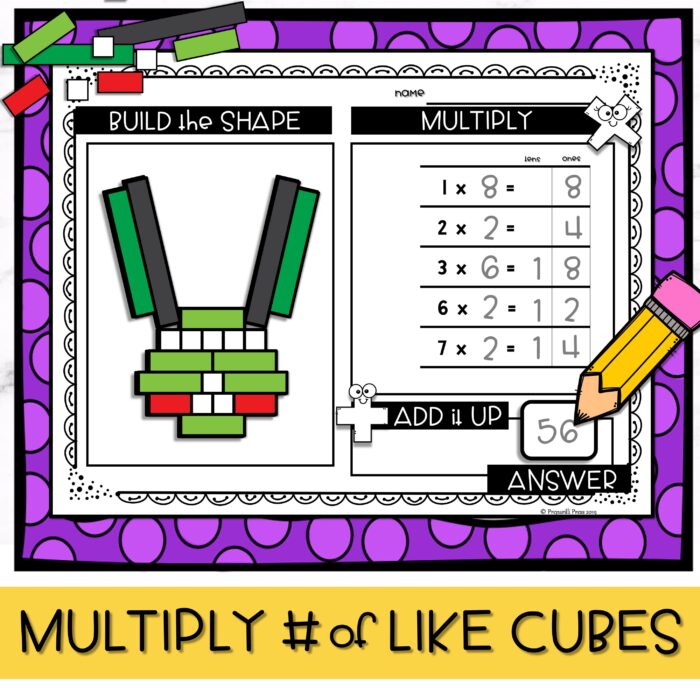
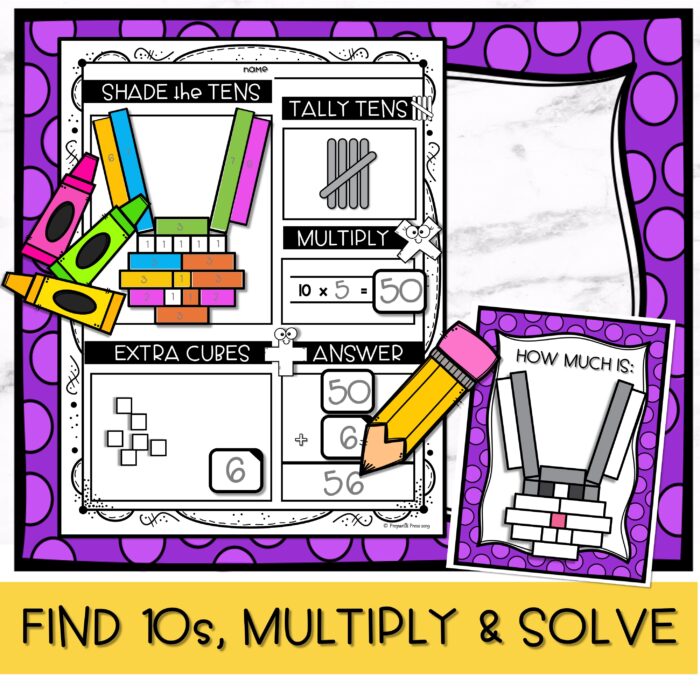
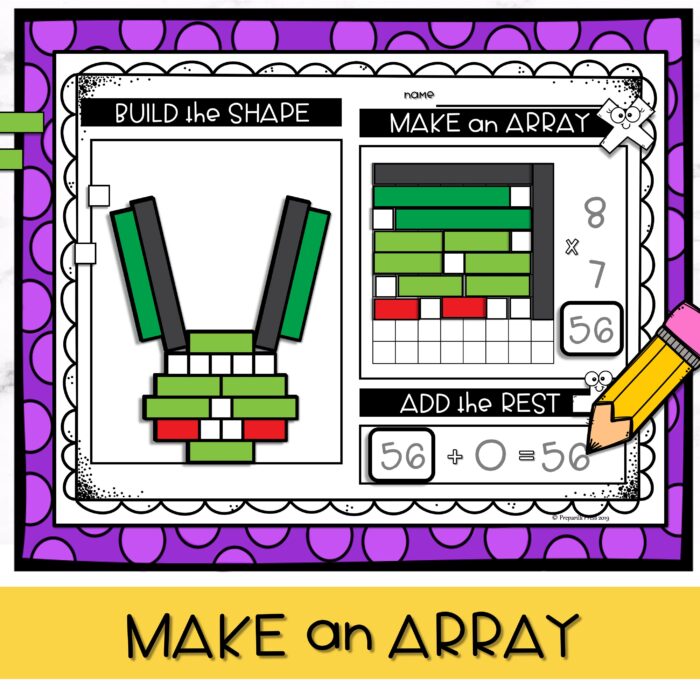
There are four activities to choose from for each of the 20 object cards.

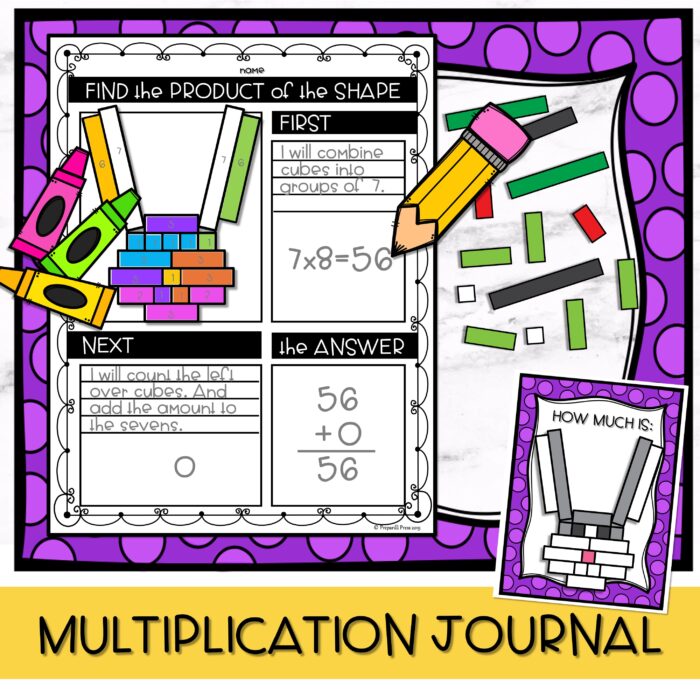
Discover how your students think through finding the product–remind them to use multiplication–as they journal their answers.

They will practice their multiplication and addition skills by combining like cubes, multiplying to discover the total value in each number set, and then adding it all up.

Or they can create sets of ten, tally and multiply and then add that value to the remaining cubes to get an object total.

Finally, they can use the Cuisenaire Rods to build an array for each object. They will multiply to discover the value of the array, add in any remaining rods and write a number sentence showing the object’s total value.

Enjoy SPRING MULTIPLICATION PROBLEM SOLVING with CUISENAIRE RODS at half off for the next 48 hours!

Something FUN (for *YOU*) on the 100th Day of School!

Your 100th Day of School celebration just got a whole lot more fun–for YOU!

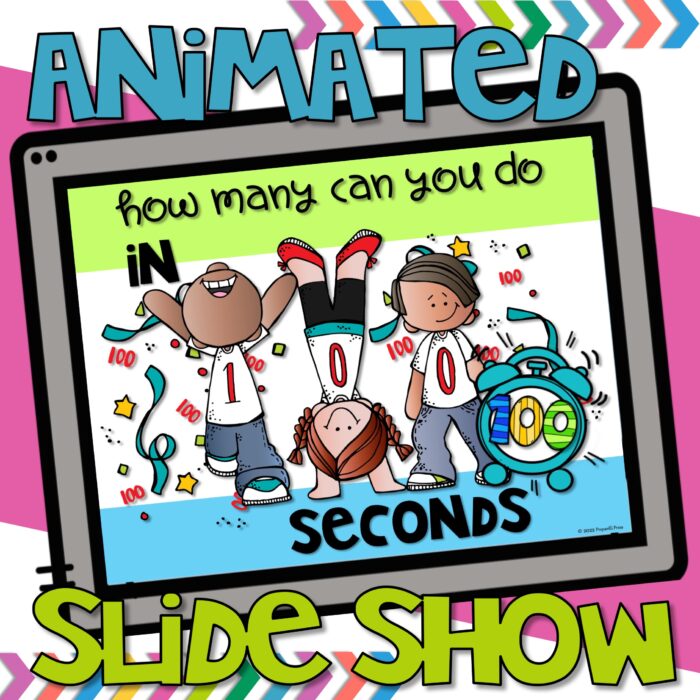
Each of the 10 activities in this PowerPoint slideshow includes a disappearing timer on its slide—set to run for 100 seconds. Your students will know to begin the activity when they hear, “YAHOO!” When the time is up, cheering will begin! Then you will advance the slideshow to the next activity.

The 10 timed activities will get your students moving and help them work on being quiet!

You can preview this product here:

To complete the activities your students will need: a die, pencil, a ball to bounce and catch, and the activity sheet* (found in the .pdf file)

TO USE: Simply open the .ppsx file and advance the slides with your arrow key. 

After your students have made their guesses on their activity sheet, click to the first activity. When everyone is ready, advance to the next slide. The YAHOO! and timer will begin; cheering will signal the end of the activity. You will advance the slides when you are ready to start the next activity.

*The activity sheet included in this download is the same sheet found in The 100th Day of School Celebration Booklet and Flapbook

You might also like these 100th Day Photo Booth Writing Prompts!

A NEW WAY TO TEACH with DICTATION!

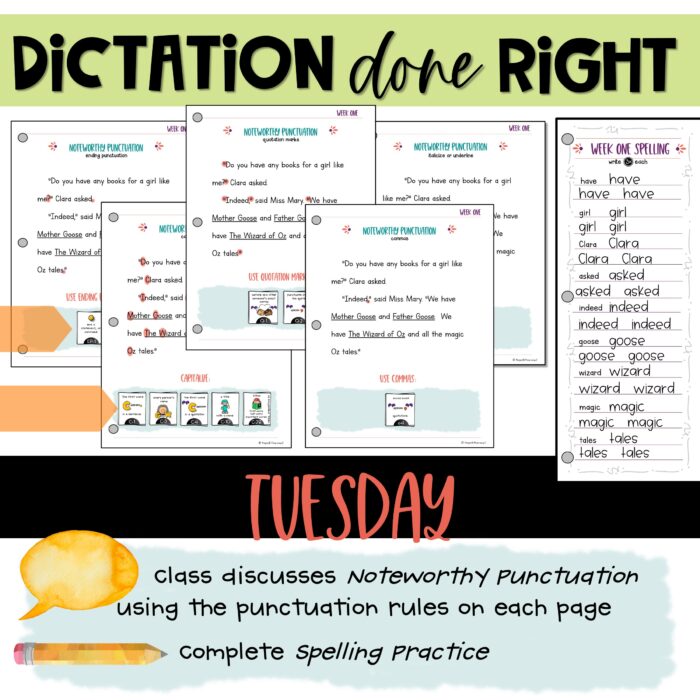
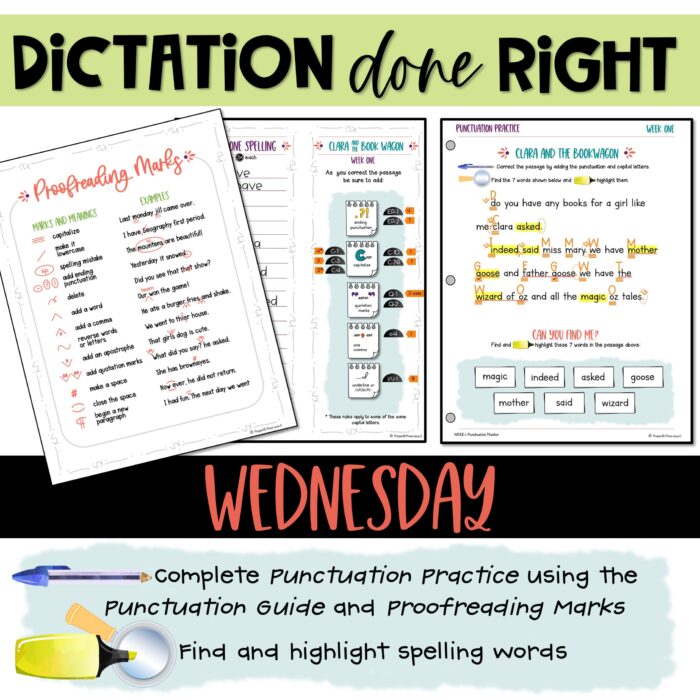
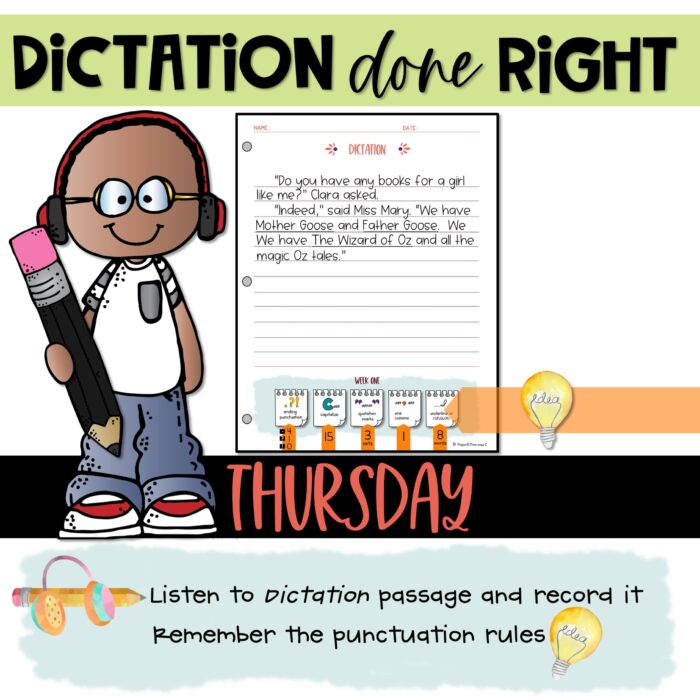
Dictation has always been a wonderful tool for improving your students’ grammar, spelling, punctuation, vocabulary and listening skills. DETAILED DICTATION DONE RIGHT  now makes it easier for you to TEACH these skills to your students!

Here is how each week will word using the DETAILED dictation program:

This set, for third graders–especially those using Sonlight’s Core C 2020 version, is currently the only set available in this new format. I will be revamping all of my other Dictation Done Right products to make them more teacher friendly.

Grab this new product today for a savings of over 50%! The first 18 weeks are included in the download. It will be completed by 18 May, or sooner.

New! My Digital Alphabet

We are rolling out a new series! These highly visual, interactive Google Slides activities will be a wonderful addition to your Letter of the Week curriculum. My Digital Alphabet is loaded with interactive F-U-N!

My Digital Alphabet will help your K and Pre-K students–

LEARN correct letter formation

IDENTIFY uppercase and lowercase letters and letter pairs

RECOGNIZE the letter’s sounds (including long and short, hard and soft sounds)

ASSOCIATE the letter sound with objects/vocabulary

Here is a look inside Letter D:

A fun way to practice correct letter formation! Grab a car and follow the signs.
These might not be wooden blocks, but they are just as effective tools for practicing letter formation.
Sorting uppercase and lowercase letters was never such fun!
Make the letter pairs complete–click, drag ‘n drop.
Can you find all of the uppercase D’s on the drinks?
How about the lowercase d’s on this dinosaur?
Let’s make sure we know this letter pair–what do you say ducklings?
And now, listen to the D sound!
Can you hear the different sounds? Show me which ones begin with D.
A fun application–a sequence activity and matching lowercase to uppercase letters. This activity is part of an existing set you can find here.
Where does a dog sleep? Where can you find a dolphin? What is the little girl holding? Let’s use our new vocabulary in context with 6 fun association puzzles!

So are you ready to TRY it? I know your students are going to love working on each slide! You can try Letter D for FREE! After you have some fun with the movable pieces, hop over and grab the My Digital Alphabet Growing Bundle! By next weekend, the price will have gone up. It will never be this low again.

REMEMBER: These activities are formatted for use on Google Slides. If you aren’t familiar with this platform, it saves changes–every change. Once you download your copy of the freebie, be sure to find “Version History” under the “File” tab. You can click on it to see all revisions and restore your copy to its original condition after each student has used it.

Daily Calendar Math for Preschoolers

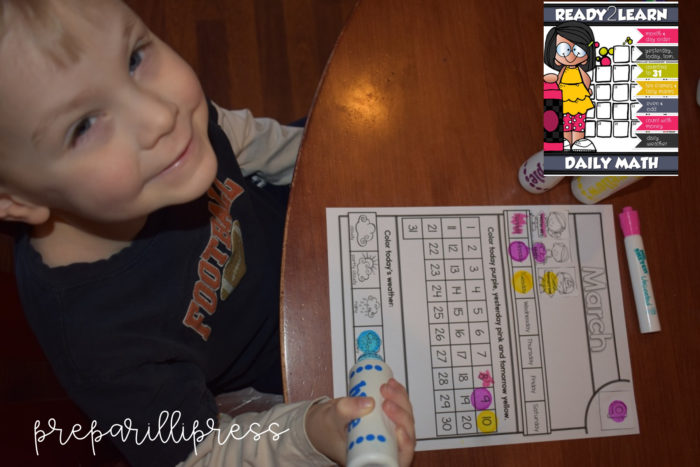
How are you integrating the calendar into your little one’s daily math? My little guy loves our Daily Calendar Math for Pre-K!

It is divided thematically into eleven months (August-June). Each month has seven sheets that can be rotated throughout the month. Because your students will be using the date to accomplish the counting problems, you can use each sheet multiple times!

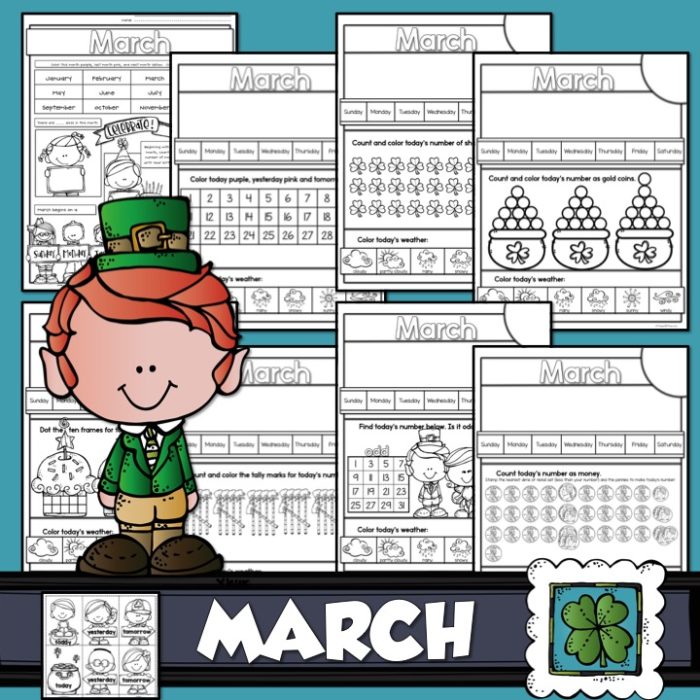
Here’s a peek at all the fun learning in store for March:

Daily Calendar Math for Kinders

Before I tell you all about this new bundle of DAILY CALENDAR MATH for KINDERS, hop over to my store and grab this freebie. It is yours, free, until 1 August!

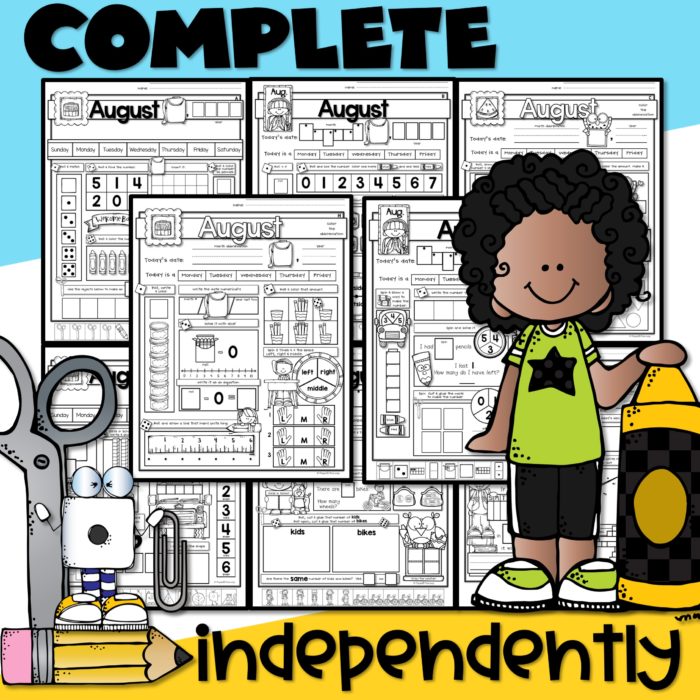
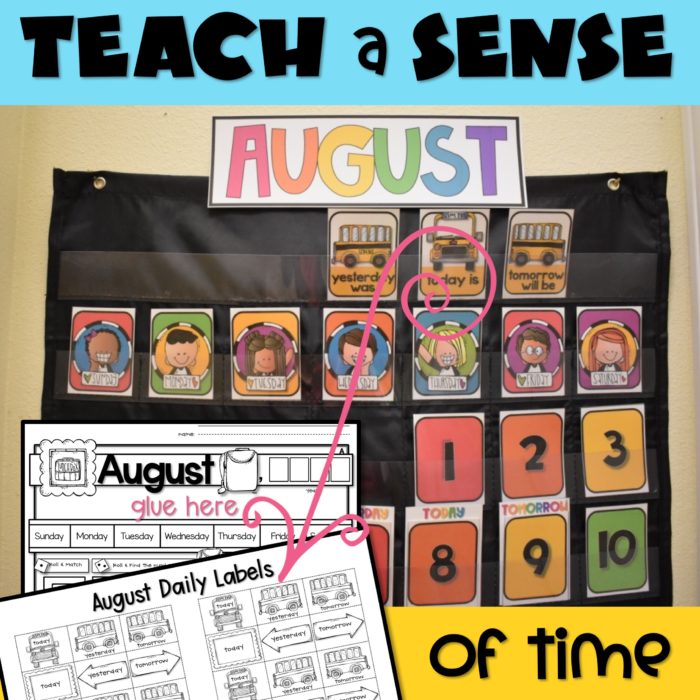
As you download each month, you will notice that you receive 3 files: 1. The DCMK file has all of the student worksheets. 2. The TLK file is a colorful Talk-To file that you can project via your Smartboard, or onto a white board and work the problems with your students. 3. The DailyLabel file has a set of Melonheadz day of the week cards (for your pocket chart calendar) and the yesterday, today, tomorrow cards for that month. These cards use direction and sequence to help teach your kinders a sense of time.

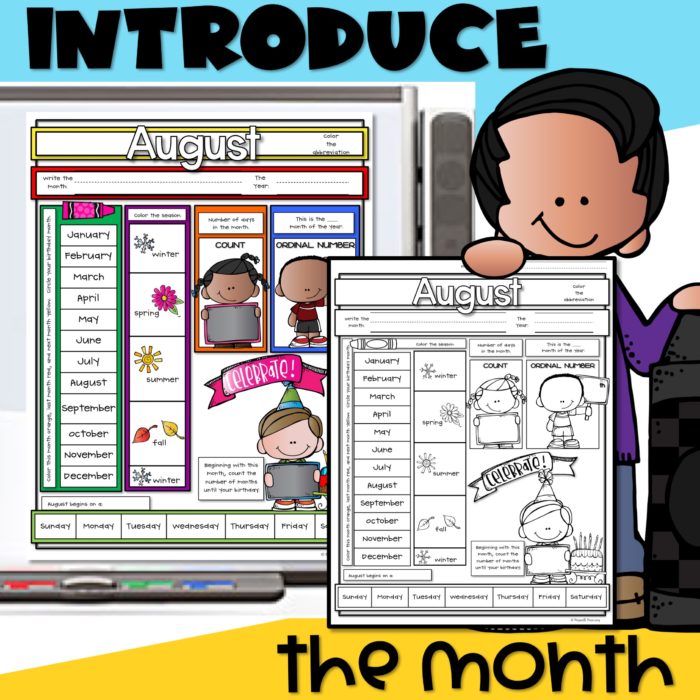
You will begin each month by introducing its essential components: how to spell the month, its abbreviation, its ordinal number, the months before and after it, its season, the year, the number of days in the month, what day of the week the month began and finally, how many months are left until your students’ birthdays.

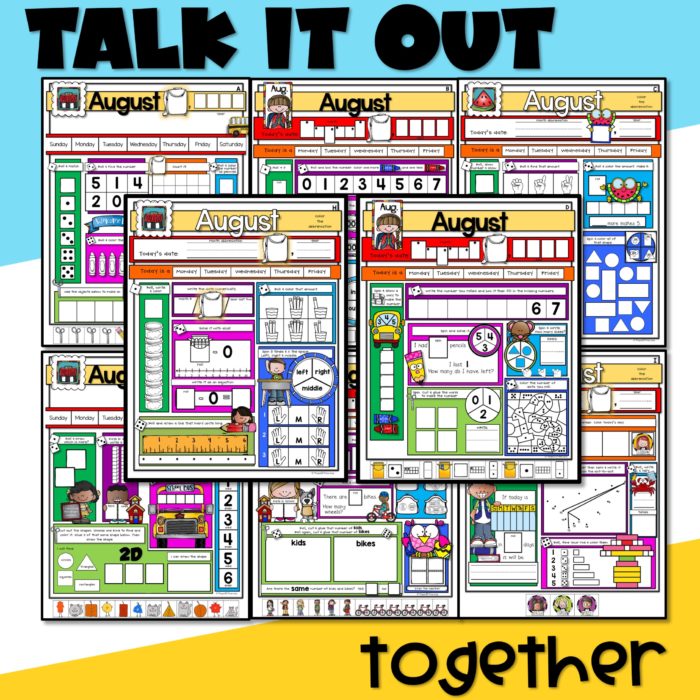
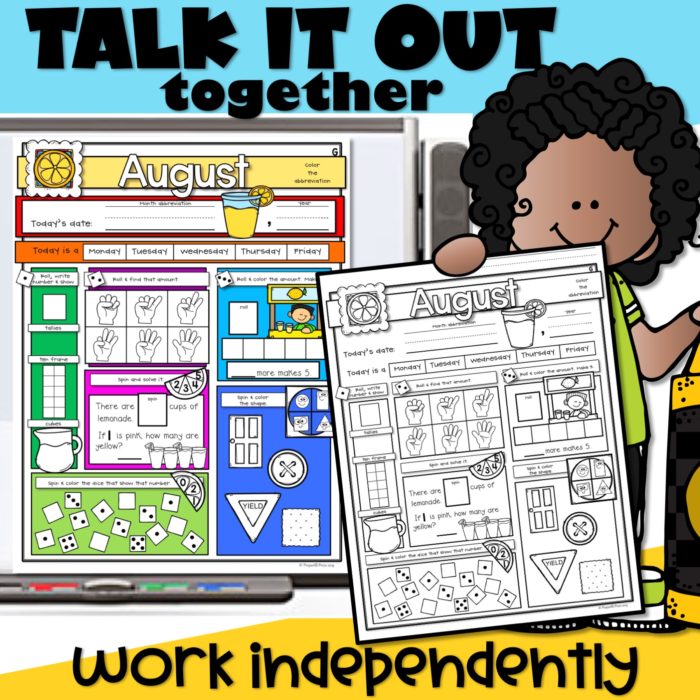
As I mentioned before, each month has a TALK-TO file. These you can project and “fill-in” with your students. Or you can simply use them to go over the directions. These TALK-TO sheets match the ones your students will be completing:

You can use manipulatives to help your students solve the daily math problems. This month focuses on the classroom, so they will count crayons, pencils, math cubes, Cuisenaire rods, Play-doh containers, kids, bikes, their fingers and pennies. They will need a die, paperclip–to spin, scissors, glue, and a crayon or pencil to complete each sheet.

There is at least one sheet each month that has a Cuisenaire rod problem. For August, the Cuisenaire problem focuses on identifying the value of each rod. Future months will ask your students to find rods that are +1 the number they rolled; find rods that =10; color the rods and skip count the number they rolled, etc. So, it would be helpful to have these rods available to build the Cuisenaire image.

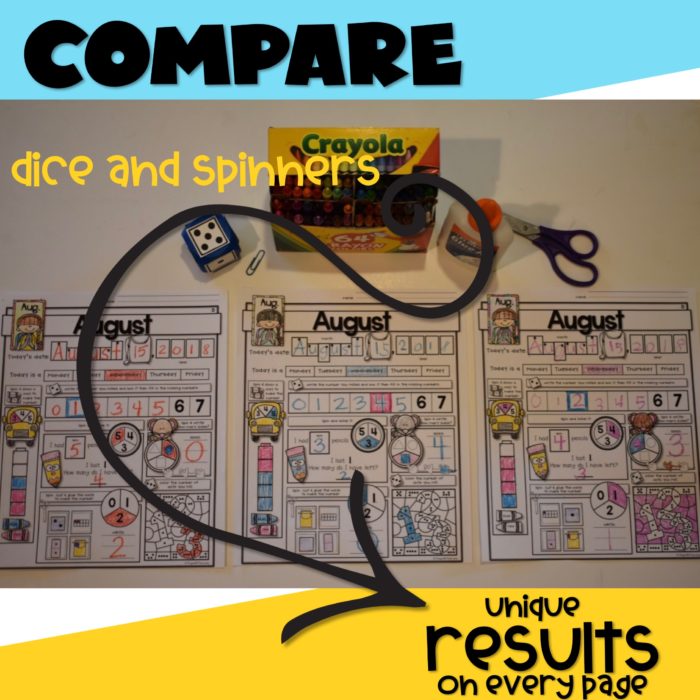
Since every problem uses dice or a spinner, you can re-use these sheets throughout the month–each time with new results. You could also have a small group MATH CHAT and discuss the unique results group of students had on the same sheet.

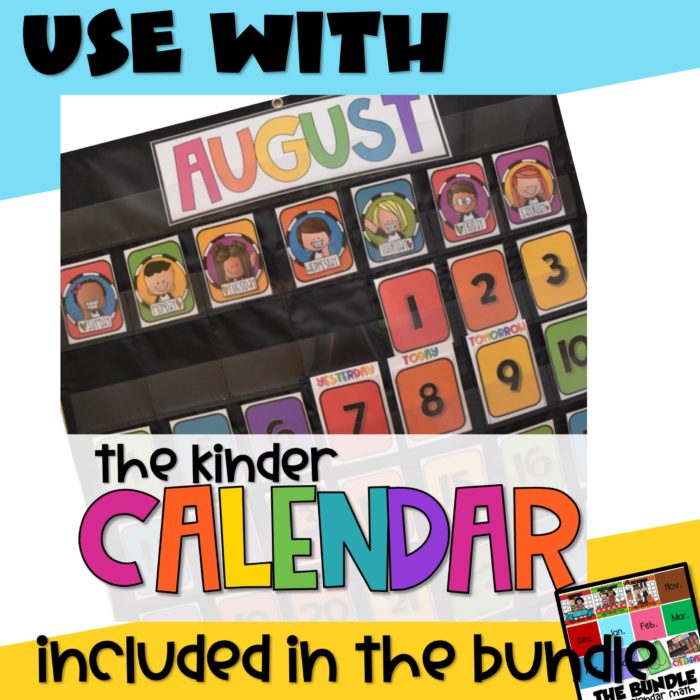
Finally, each month has its own set of daily labels. August focuses on direction, but subsequent months include sequence cards to teach a sense of time. Your students will use the daily labels on a few of their worksheets. But, you can use them with your pocket chart calendar. The calendar we use with DAILY CALENDAR MATH for KINDERS is called the KINDER CALENDAR and it is included in the bundle!

If you haven’t grabbed AUGUST, what are you waiting for? You are going to find this pack is not only a good teaching tool, but also a great way to assess your students’ math skills!